what’s next
MORE JOHNNY
A new band on the way, a playlist, and where to follow.

Four Door Sedans
The upcoming project of Johnny Ashburn, The Ashburns and Ol’ June – with a special guest.
Follow on Instagram ↗a soul studio in Ingolstadt
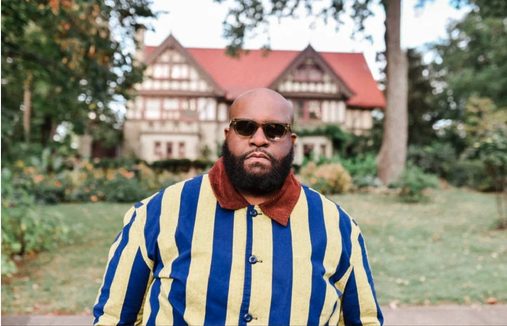
Johnny Ashburn – real name Jonas Aschenbrenner – is a soul producer and musician from Ingolstadt: “the new vintage”, soulful moods inspired by the sounds of the 60s, 70s and 80s. A fresh project, an old friend: Johnny has worked a lot with Audi Bamer – and his alter ego is Jone C Fyah. This is his room – oak slats, warm light, a tape machine and two congas. Sit down, dig through the records, sing a few harmonies at the mic and learn how vintage vocals are mixed.
Tap the left conga for the high drum, the right one for the low drum.
dig through the basket
Pull a record out of the basket.
More records are on their way into the basket.
the vocal booth
Three voices, one sound: the lead sings the melody, you set the high and the low harmony – like a soul or rocksteady vocal trio. First the doo-wop progression in C, then a soul ii–V–I with seventh chords. Tick off the rules, then let the trio sing.
▲▼ a semitone, ⇈⇊ an octave. Each step sings the new note.
Solve all chords of a progression and the trio sings it through.
In close harmony the upper voices sit tightly together, within one octave. Open harmony spreads the same chord notes further apart. A soul or rocksteady trio usually sings close, so the three voices blend into one sound.
A triad is a three-note chord built from stacked thirds: root, third and fifth. With the lead plus a high and a low harmony, your trio can cover all three notes of the chord, one note per singer.
The simplest harmony line follows the shape of the melody a third above or a third below it. Flip a third into the other octave and it becomes a sixth, so parallel sixths work the same way. Parallel thirds usually sound fine even where they don't strictly fit the chord.
Your harmony notes should belong to the chord that is playing. If the note a third away is not in the chord, another interval such as a fourth can sound better, as long as that note is a chord tone.
When the chord changes, keep any note the two chords share. Move the other voices to the nearest chord tone of the next chord, mostly by step and with few leaps: take the elevator, not the stairs.
The high harmony should always stay above the lead, and the low harmony below it. If one part dips past its neighbour, that is called voice crossing, and classic part-writing avoids it. Also keep neighbouring upper voices no more than an octave apart.
I–vi–IV–V (in C major: C–Am–F–G) is known as the doo-wop or '50s progression. It got its name from its frequent use in 1950s and early-1960s ballads and is still common today.
A seventh chord has four notes, but your trio only has three voices, so something has to go. The 3rd (major or minor) and the 7th define the chord's sound; the 5th is the usual note to leave out.
The game uses the classic part-writing ranges: alto G3–D5 for the high harmony, tenor C3–G4 for the low one. Falsetto is the upper register of the voice, the opposite of chest voice: the vocal folds vibrate along a shorter length than usual. It lets a singer, especially a tenor, sing above the range of the full voice.
In a typical doo-wop group, a tenor lead sang the melody while a trio or quartet sang the harmony behind them. The name 'doo-wop' comes from the nonsense syllables the backing singers used.
Doo-wop grew out of African American communities in big US cities from the late 1940s. Many young groups couldn't afford instruments, so they sang a cappella and rehearsed on street corners and stoops, or in hallways and stairwells where their voices echoed.
Gene Chandler's 'Duke of Earl' (1962) is a textbook example of the I–vi–IV–V progression, which is so tied to doo-wop that it is often just called the doo-wop progression.
The Andantes were Motown's in-house female backing trio. Without credit, they sang on hits like Mary Wells' 'My Guy' and Marvin Gaye's 'I Heard It Through the Grapevine'. AARP and BlackPast both put their output at more than 20,000 Motown recordings.
The Impressions' harmonies, with Curtis Mayfield, became a major model for Jamaican vocal trios. The Rock & Roll Hall of Fame calls them 'a primary influence for dozens of West Indian vocal trios, from the Heptones to Bob Marley's Wailers.'
The Wailers started in 1963 in Trench Town, Kingston, around the vocal trio of Bob Marley, Peter Tosh and Bunny Wailer. By late 1963 the singers Junior Braithwaite, Beverley Kelso and Cherry Smith had joined them. The singer Joe Higgs coached them, and Bunny Wailer took on a big share of the harmony singing.
The Heptones were a Jamaican harmony trio, inspired by American R&B groups such as the Drifters and the Impressions. They recorded a long run of hits during a five-year stretch at Coxsone Dodd's Studio One.
Heptones lead singer Leroy Sibbles did more than sing at Studio One. He also played bass on many sessions and worked as one of the studio's arrangers.
'The Tide Is High' started out as a rocksteady song. John Holt wrote it and recorded it in 1967 with his vocal group the Paragons, produced by Duke Reid for Treasure Isle. Blondie's 1980 cover went to No. 1 in both the US and the UK.
The trio is a synthesizer, not a real choir. Game rules simplified from the part-writing rules above; ranges from Open Music Theory.
at the desk
A short course for the new-vintage sound: twelve lessons on vintage-style lead vocals and harmony stacks – mics, tape, EQ, compression, chambers, plates, slapback, doubling and the final checks. Each lesson ends with something to try in your own DAW. Every number comes from the source named next to it.
Vintage vocals come from the limits of the era as much as from the gear. Universal Audio notes that most of the classic Motown sound was recorded on 8 tracks. Abbey Road points out that every extra tape generation degraded the high end, and that committing to decisions early shaped those records. Typical ingredients: tape warmth, a short slap delay, mono reverbs and gentle console EQ. In your DAW: put a subtle tape emulation on every vocal track, keep reverbs mono or panned to the same spot as their source, and commit stacked background vocals to a single mono or stereo track.
TRY ITDuplicate a finished vocal session. In the copy, add a subtle tape emulation to each vocal, set all reverb returns to mono and bounce the background stack to one track. A/B both versions at matched loudness and write down three differences you hear.
Large-diaphragm tube condensers shaped many classic vocal sounds. Neumann describes its U 47, introduced in 1949, as adding a ‘noble sheen’ to voices. Ribbon mics are figure-8 and are often heard as smoother on top, because the ribbon has no resonance in the high range like capacitor mics do. Directional mics show proximity effect: the bass rises as the singer moves closer. It is strongest with figure-8, about half as strong with cardioid and absent with omni. Use distance like an EQ: closer for warmth, further back for a lighter, more natural tone. Singing slightly across the mic also reduces the bass rise.
TRY ITRecord the same phrase three times with a directional mic: one hand-width away, two hand-widths, and at arm’s length. Match the levels afterwards and compare the low end and how ‘close’ each take feels.
Tape does more than ‘warm things up’: it squashes transients, adds harmonic distortion and compresses pre-emphasised high frequencies more than lows. How it reacts depends on tape type, bias, record EQ, level, speed, tape width and the machine’s electronics, and its character changes with level instead of simply getting stronger. At 15 ips, tape adds a low-frequency ‘head bump’. Universal Audio describes an overdriven tape sound on many 60s soul recordings. In your DAW: insert a tape emulation on the vocal, start subtle, then raise the input in small steps while keeping the output level matched.
TRY ITLoop a vocal phrase through a tape emulation. Raise the input in small steps, matching the output each time. Note the point where consonants start to blur, then back off one step.
Start by removing what you don’t need. Sound On Sound notes that most mic and preamp low-cut filters sit around 80 Hz, which helps with rumble and plosives. Harshness typically lives around 2–5 kHz, while engineers interviewed by SOS describe 1–4 kHz as the presence zone. For brightness, SOS suggests a touch of high-shelf boost at 8 kHz. For a vintage flavour, work like the old consoles, whose basic tone controls had gentle curves: few, broad moves rather than sharp, surgical ones. Abbey Road notes that tape generations dulled the high end back then, so try a gentle high-cut and judge by ear.
TRY ITEQ a lead vocal using no more than three wide bands plus a low-cut. Then add a gentle high-cut and move it down until the voice stops cutting through, then back up. A/B against bypass at matched level.
Two classic characters: an opto leveler reacts smoothly and program-dependently. Universal Audio gives the classic opto unit an average attack of 10 ms and a release of about 60 ms for the first half, then 1–15 seconds for the rest. A FET limiter is very fast: UA’s manual lists 20–800 µs attack and 50 ms–1.1 s release. Sound On Sound suggests a serial chain with a fast compressor first, catching peaks by about 3–4 dB, then the slow leveler for smooth body. As a general starting point, SOS names 2:1–4:1, around 10 ms attack, 50–100 ms release and no more than about 5 dB of gain reduction on peaks.
TRY ITBuild a fast-then-slow chain on a lead vocal. Set the first stage to shave only the loudest peaks, then let the second stage level gently. Solo each stage, then both, and watch the gain-reduction meters while you listen.
Sibilance usually sits somewhere between 4 and 10 kHz and is often much louder there than anything else in the recording. A de-esser listens only to that region in its sidechain, so it reacts just when an ‘s’ hits; dynamic-EQ types turn down only that band. Find the spot by sweeping, then set the threshold so only the esses trigger it. Don’t overdo it: too much and the singer starts to sound like they’re lisping. Alternatives: move single esses to their own track or lower them with automation. Sound On Sound also suggests a de-esser before the reverb on the reverb bus, where you can be heavier.
TRY ITPick a sibilant line. De-ess it once by ear with a de-esser and once by hand with clip gain or automation. Then add a bright reverb and try a de-esser before it on the reverb bus. Compare all three.
An echo chamber is a reflective room with a speaker and microphones; the result is blended back into the track. Abbey Road converted a room into its Studio Two chamber in the mid-1950s, and Motown’s Hitsville had chambers in the attics. The plate arrived in 1957: a large metal sheet with a driver and pickups, bright and very dense. Using them today: put the reverb on a send and add pre-delay so words stay clear; in Sound On Sound, Mike Senior demonstrates 35 ms on a vocal. Filter the return: a high-pass somewhere in the 100–300 Hz range, plus a gentle high-cut.
TRY ITSend a vocal to a plate or chamber emulation. Compare 0 ms and 35 ms pre-delay, then add a high-pass and a gentle high-cut on the return. Decide which version keeps the words clearest while still sounding ‘in the room’.
At Sun Records in Memphis, Sam Phillips fed channels into a second tape recorder and blended its delayed playback back in; changing that machine’s speed changed the echo. Tape slap became part of the early rock ’n’ roll sound, heard on Elvis Presley’s Sun singles from 1954. Slapback is a single repeat with little or no feedback, typically 60–250 ms. For a 60s vocal, Abbey Road suggests about 120 ms with some tape drive. In your DAW: one delay on a send, feedback near zero, kept mono behind the voice. Sound On Sound suggests a low-pass on tape-style repeats, somewhere between 2 and 5 kHz.
TRY ITStart a slapback at 120 ms on a send. While the song plays, sweep the time slowly shorter and longer and notice where the echo pushes the groove or drags it. Pick the time that sits best, then set the low-pass by ear.
Real double tracking means singing the same part twice. Because that took time and a valuable tape track, Abbey Road engineer Ken Townsend developed Artificial Double Tracking during the Beatles’ Revolver sessions in 1966. A second, speed-controlled tape machine replayed the vocal slightly offset, normally by 8–12 ms, and the second voice could even be placed before or after the original. In your DAW: record a real double, or copy the vocal through a short, slowly modulated delay. Sound On Sound’s Mike Senior notes that opposition-panned doubles should usually be at equal level, so check in mono as soon as you pan.
TRY ITRecord a real double of a chorus line. Then build an ADT-style copy with a delay around 8–12 ms and slow modulation. Compare both, first centred, then panned left and right, and check each in mono.
Several singers around one mic often blend more naturally because they balance each other in the room. Pick the polar pattern by layout: figure-8 for two singers facing each other, cardioid for a half-circle, omni to surround the mic. Balance by moving singers closer or further away, but keep them close enough that the room doesn’t take over. Bobby Owsinski suggests rotating singers so each part gets recorded on-axis, and taking a step back for every additional overdub while matching the preamp gain. Vary something on each pass, such as mic, distance or room. If tuning suffers, let singers lift one headphone side.
TRY ITRecord a three-part harmony with three singers around one cardioid mic in a half-circle. Adjust the blend only by distance. Then record a second pass with everyone one step further back and compare.
Route all background vocals to one bus so you can treat and ride them like one instrument. To keep them behind the lead, Sound On Sound’s Paul White suggests a high-pass around 150–200 Hz and a high-cut on the backing parts rather than piling on reverb. For a 60s character, Abbey Road suggests committing stacks to one mono or stereo track and keeping reverbs mono, and notes that radical left-centre-right panning was a feature of early stereo mixes. Keep the lead in the centre, and remember that a part panned hard left or right loses up to about 3 dB when the mix is summed to mono.
TRY ITGroup a background stack on one bus. Add a high-pass and a high-cut, then try two panning ideas: a wide spread and a strict left-centre-right layout. Check both in mono and against the lead.
Even a heavily compressed vocal can sound uneven, because the backing track masks it more in some places than in others. Sound On Sound’s Paul White notes that volume automation often controls a dynamic vocal more transparently than extra compression. Ride the lead phrase by phrase first, then fix single words; ride the background bus so it supports the lead without covering it. Final checks: listen in mono, because opposition-panned doubles and stereo parts can lose level or change tone through phase cancellation. Compare your mix in mono with commercial records too, and check the lead-to-background balance once more.
TRY ITWrite volume automation for one verse of lead vocal: phrases first, then single words. Then switch the master to mono and listen for doubles, background parts or reverbs that drop out or change tone.
Settings are starting points from the sources, not rules – trust your ears. Gear is described generically; plug-in emulations of the classic units work the same way.
from the jukebox
48 facts about soul music – from gospel churches and Motown to Memphis, Muscle Shoals, Cincinnati, Philadelphia, the Northern Soul all-nighters and today’s new vintage. Drop the needle and the jukebox picks one, or choose a chapter. Every fact comes with its source.
what’s next
A new band on the way, a playlist, and where to follow.
The upcoming project of Johnny Ashburn, The Ashburns and Ol’ June – with a special guest.
Follow on Instagram ↗